
Sustainability Starts at the Surface: Why Montalbano Chooses Eco-Friendly Tabletops
17 July 2026
When people think about sustainable furniture, they often picture the frame, the legs, or the finish. But for commercial spaces (restaurants, hotels, offices, co-working hubs), the tabletop is where sustainability really gets tested. It’s the surface that takes the daily abuse: spills, scratches, sun exposure, constant cleaning, and years of use under demanding conditions.
 At Montalbano, we choose eco-friendly materials for our tabletops for two core reasons: durability and environmental responsibility. And the truth is, these two things aren’t separate goals; they reinforce each other.
Reason 1: Durability That Makes Sense for Commercial Use
Commercial furniture lives a different life than furniture at home. A café table might be wiped down fifty times a day. A hotel lobby table might sit under direct sunlight for years. A restaurant tabletop has to survive hot plates, wine spills, and the occasional dropped fork, repeatedly, for a decade or more.
Eco-friendly materials like HPL (High-Pressure Laminate), laminate, Gres porcelain, and responsibly sourced solid wood aren’t just “green” choices; they’re often more resilient than conventional alternatives:
- HPL (High-Pressure Laminate) is built from layers of resin-impregnated paper fused under extreme heat and pressure, making it highly resistant to scratches, impact, heat, and moisture, exactly what a busy restaurant or hotel table needs to withstand.
- Laminate surfaces offer excellent resistance to staining and fading, hold up well under constant cleaning with commercial-grade products, and keep their appearance over years of heavy use.
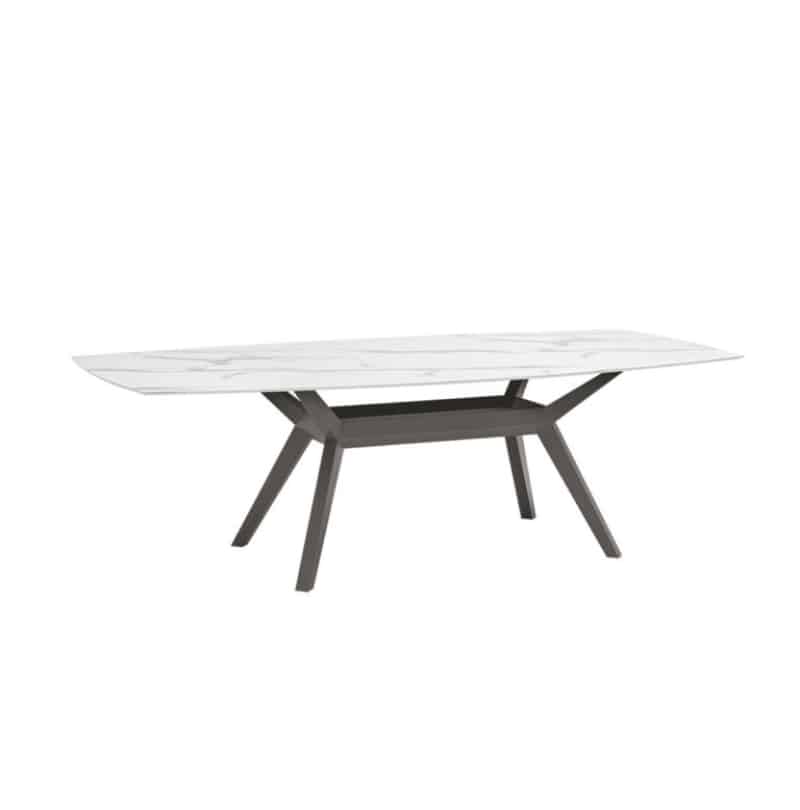
- Gres porcelain (porcelain stoneware) is fired at very high temperatures, making it extremely dense, scratch-resistant, and virtually impervious to stains, heat, and UV fading, a strong eco-friendly alternative to marble for surfaces that need to perform outdoors or in heavy-use commercial settings.
Alongside these surface materials, we also use solid wood in parts of our tabletop collections; and that wood is treated as its own, separate sourcing category.
At Montalbano, the wood we use is FSC Controlled Wood. This is a Forest Stewardship Council classification that sets a minimum standard for responsible sourcing. Unlike full FSC certification, Controlled Wood isn’t necessarily sourced from a certified forest, but it’s still verified to exclude wood from the riskiest sources. Specifically, FSC
Controlled Wood must avoid:
- Illegally harvested timber
- Wood harvested in violation of traditional or civil rights
- Timber from forests where high conservation values are threatened
- Wood from forests being converted to plantations or non-forest use
- Timber from areas where genetically modified trees are planted
In practice, this means every piece of wood in our tabletops has been traced and checked against these risk categories before it reaches production. It’s a meaningful safeguard against deforestation and unethical logging, and it’s often used alongside FSC-certified material to create mixed-source products that still meet strict responsibility standards.
For a business owner, that translates directly into value: fewer replacements, fewer repairs, and a lower total cost of ownership over the life of the piece.
Reason 2: Real Environmental Impact at Commercial Scale
Commercial furniture is purchased in volume. A single hotel or restaurant chain might order dozens or hundreds of tabletops at once. At that scale, material choice has a real environmental footprint: good or bad.
Choosing eco-conscious materials means:
- Reducing deforestation pressure by sourcing our solid wood components to FSC Controlled Wood standards
- Avoiding materials linked to illegal logging or high-risk forestry practices
- Cutting down on landfill waste, since HPL, laminate, and Gres porcelain surfaces resist wear and don’t need replacing every few years
For businesses working toward sustainability commitments (whether for ESG reporting, brand values, or client expectations), the tabletop is a visible, tangible way to demonstrate that commitment. It’s the surface every customer touches.
Durability and Sustainability: The Same Decision
This is the core of Montalbano’s philosophy: a genuinely sustainable material has to perform. A tabletop that needs replacing every two years isn’t eco-friendly, no matter what it’s made of; the waste, transport, and manufacturing emissions of constant replacement cancel out any “green” label.
That’s why we don’t treat durability and sustainability as a trade-off. We treat them as the same requirement, seen from two angles. A material that lasts is a material that respects resources. And a material that respects resources, chosen well, tends to last.
See these materials in person at our Al Quoz showroom, where our team can walk you through HPL, laminate, and Gres porcelain samples side by side and help you choose the right finish for your project’s demands. Explore our commercial collections or get in touch to start the conversation.
FAQs
Why does Montalbano choose eco-friendly materials for its commercial tabletops?
Montalbano chooses eco-friendly materials for two main reasons: durability and environmental responsibility. In commercial spaces, a tabletop must withstand spills, scratches, heat, moisture, sunlight, constant cleaning, and years of frequent use. Materials that last longer also help reduce unnecessary replacement and waste.
Are sustainable table tops durable enough for restaurants and hotels?
Yes. Sustainable table tops made from materials such as HPL, laminate, Gres porcelain, and responsibly sourced solid wood can meet the demands of restaurant furniture, hotel furniture, offices, and other busy commercial settings. Their resistance to scratches, stains, heat, moisture, fading, and frequent cleaning supports long-term use.
Which eco-friendly tabletop materials are suitable for commercial use?
Montalbano uses HPL, laminate, Gres porcelain, and responsibly sourced solid wood across its tabletop collections. HPL and laminate are practical for frequently cleaned surfaces, while Gres porcelain performs well in heavy-use and outdoor furniture settings. Solid wood is treated as a separate, responsibly controlled sourcing category.
What is FSC Controlled Wood, and why does it matter?
FSC Controlled Wood is a Forest Stewardship Council classification that sets a minimum standard for responsible sourcing. It is verified to exclude wood from high-risk sources, including illegally harvested timber, forests where traditional or civil rights are violated, threatened high-conservation-value forests, converted forests, and areas where genetically modified trees are planted.
How do durable commercial tabletops help reduce environmental impact?
Durable commercial tabletops require fewer replacements and repairs over time. This can reduce landfill waste and the transport and manufacturing emissions linked to frequent replacement. For business owners, long-lasting commercial furniture can also support a lower total cost of ownership over the life of each piece.


