
Outdoor Furniture for UAE Villas
2 September 2026There is a particular kind of disappointment that arrives in October. The summer heat finally lifts, villa owners step back onto their terraces, and the outdoor furniture that looked considered and expensive eighteen months ago looks tired. The cushion fabric has shifted tone, not dramatically, but noticeably. The frame finish has a dullness to it that wasn’t there before. A joint is loose. Nobody did anything wrong. The furniture simply wasn’t built for where it was asked to stand.
This happens more often than it should when furnishing outdoor furniture UAE–wide, and it happens for a straightforward reason: most outdoor furniture is specified against European or American conditions, then sold into a climate that benchmarks don’t describe. A summer in the Emirates is not a summer in Tuscany or California. It is sustained heat above 45°C for months at a time, UV intensity that sits in the extreme classification for more than half the year, coastal humidity that pushes past 80% on many nights, and a fine particulate dust that works its way into every weave, joint, and mechanism. These conditions don’t just age furniture, they expose every shortcut in how it was made.
Understanding what the climate actually demands, and matching materials and construction to those demands, is the difference between a UAE villa outdoor space that holds its quality for a decade and one that quietly disappoints by the second season.
The Four Stresses That Decide Everything
Before choosing any piece of villa furniture, it’s worth naming the four forces that will work on it from the day it’s placed outdoors.
The first is UV radiation. In the Emirates, ultraviolet intensity is not a seasonal concern, it is a year-round constant. It breaks down surface finishes, degrades polymer chains in synthetic materials, and bleaches fabric from the outside in. The question it forces is whether a material’s colour and integrity run all the way through its structure, or whether they sit on the surface waiting to be stripped away.
The second is thermal cycling. Outdoor surfaces in direct UAE sun can reach 60°C or above in summer afternoons and cool significantly overnight. This expansion and contraction, repeated daily over months and years, loosens joints, stresses adhesives, and works on any material that isn’t dimensionally stable under heat. It’s the reason cheap glues and low-grade powder coatings fail long before the underlying material would.
The third is humidity, which behaves differently here than the word suggests. The UAE is not a uniformly dry desert environment. Coastal areas like Palm Jumeirah, Dubai Marina, Abu Dhabi’s waterfront, and the Jumeirah coastline experience summer humidity that regularly exceeds 80%, sometimes approaching 90% on August nights. That moisture, combined with airborne salt particles carried on sea winds, accelerates corrosion on metals, promotes mould in fabrics that trap rather than drain, and penetrates any protective coating that wasn’t applied thoroughly.
The fourth is dust, the fine desert particulate that settles into rope weaves, cushion seams, frame joints, and swivel mechanisms with every Shamal wind. It’s abrasive when it accumulates, and it carries salt. A piece that looks clean may have months of particulate working slowly against its surfaces.
These four forces act simultaneously. The furniture that lasts in a UAE villa is the furniture that was built with all four in mind, not just the one that’s most visible.
Materials: What Each One Actually Does
Powder-coated aluminium
The correct foundation for most outdoor furniture Dubai homeowners rely on, with a specification detail that matters. Aluminium itself doesn’t rust, which resolves the corrosion problem for the bulk of the frame. What degrades is the coating. A quality baked-on polyester powder coat bonds to the aluminium rather than sitting over it, which means UV and heat work on it far more slowly than an electrostatically applied alternative. The distinction isn’t visible in a showroom. It becomes visible two summers in, when one frame looks exactly as it did and another has started to chalk and dull. For poolside settings, the fixings deserve equal attention; aluminium frames assembled with standard steel screws will show rust at every fixing point within a season or two. Stainless steel fixings throughout are the correct specification for any piece near water.
Teak
Teak occupies a different category. Its natural oil content gives it a genuine resistance to UV, moisture, chlorine, and salt that no engineered material fully replicates, and it stays cooler to the touch in direct sun than an aluminium or ceramic surface, a real comfort consideration for the sun loungers and outdoor seating furniture people will actually use in warm weather. The one thing worth understanding before choosing teak is that it will fade. Left untreated, it transitions from warm honey-brown to a silver-grey within the first six to twelve months outdoors, and that process is irreversible without intervention. Unlike most outdoor materials, teak requires active maintenance to preserve its original appearance: annual oiling to replenish the surface oils, periodic cleaning to prevent mould forming in the grain, and occasional sanding if the surface becomes rough over time. If that upkeep isn’t part of the plan, the silver-grey patina is a perfectly valid outcome, but it should be a choice, not a surprise.
Sintered stone and outdoor-grade ceramics
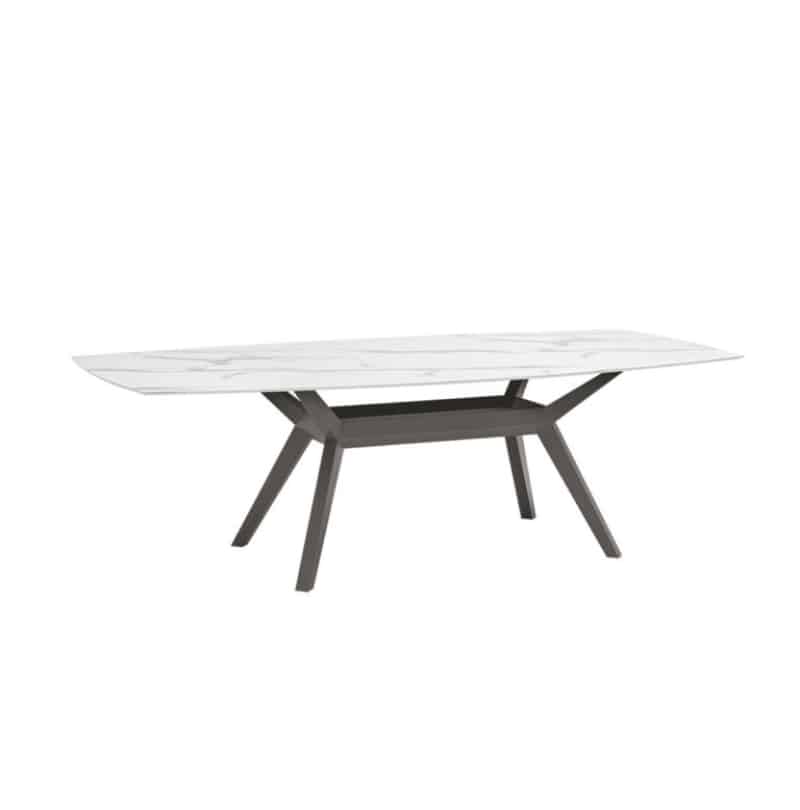
The right answer for tabletops in any setting that sees direct sun. Natural stone, including marble, becomes porous over time under UAE UV, absorbs moisture, and in coastal areas develops salt deposits on its surface that affect both appearance and integrity. Sintered stone, fired at extreme temperatures into a near-impermeable surface, doesn’t. It resists heat, doesn’t stain without immediate intervention, and holds its surface quality under conditions that would gradually compromise natural alternatives. The aesthetic difference is minimal at the point of selection; the performance difference over five years is significant.
Rope and synthetic weaves
These vary more than almost any other material used in outdoor seating furniture, and the variance is invisible until it’s too late. High-quality UV-stabilised rope, typically an olefin or acrylic exterior over a rubber-core structure, retains its colour, flexibility, and tensile strength under sustained Gulf sun for years. Lower-grade synthetic rope bleaches and becomes brittle on a timeline measured in seasons rather than years. The stabiliser content embedded in the fibre at manufacture determines this outcome, and it’s not something visible from appearance or touch. It has to come from knowing who made it and to what standard.
Outdoor upholstery fabric
Solution-dyed fabric, where colour pigment is locked into the polymer before the fibre is extruded rather than applied to the surface afterwards, holds its tone under UV exposure in a way that surface-dyed alternatives cannot. The colour runs through the entire fibre rather than sitting on it. This is why well-specified outdoor upholstery can spend years on a south-facing UAE terrace and still be read as considered and intentional, while cheaper alternatives look washed-out within a season. Quick-dry foam construction matters equally: cushions that retain moisture become heavy, develop odour, and eventually harbour mould. Open-cell or perforated foam drains rather than holding water, which means the cushion recovers properly after a coastal evening rather than staying damp.
Where Each Piece Stands: Matching Specification to Location
A UAE villa’s outdoor area is not a single environment. A shaded terrace, an open garden, and a poolside deck each impose different conditions, and specifying villa furniture identically across all three means accepting compromises that don’t need to be made.
Poolside is the most demanding zone. Chlorine from the pool accelerates the degradation of any protective finish that wasn’t designed for chemical exposure, and the wet-dry cycling that happens dozens of times across a season works on joints, cushion foam, and frame coatings simultaneously. Teak handles poolside conditions as well as any material; its natural oils resist chlorine without special treatment. For aluminium frames in poolside settings, the powder-coat specification and the quality of the fixings matter more than in any other location. Quick-dry cushions are not optional here; they’re the difference between furniture that’s always ready to use and furniture that’s perpetually slightly damp.
Covered terraces allow more generosity in the specification. Pieces that would struggle in constant direct sun, richer upholstery, more delicate weaves, and hardwood frames, can perform well when they’re protected from the worst of the UV and rain. The risk that increases on a covered terrace, particularly in coastal areas, is humidity rather than sun: frames and cushion structures need to breathe rather than trap moisture overnight.
Open gardens and lawn areas introduce a different variable: sustained moisture at ground level from irrigation. Frame feet and lower joints take more wear here than anywhere else on the piece, and fabric that sits close to ground level needs genuine mould resistance rather than a surface treatment. Rust-resistant frame specification is non-negotiable in irrigated garden settings, even if the garden looks and feels dry most of the time.
Designing the Indoor-Outdoor Connection
The most overlooked dimension of villa furniture is how it reads from inside the house, and how the outdoor scheme ages relative to the interior over time.
The instinct is to colour-match: find outdoor pieces in the same tonal family as the interior and treat the problem as solved. This creates a scheme that looks cohesive on the day of installation and drifts gradually thereafter, because outdoor materials weather at a different rate and in a different direction than interior ones. A warm-toned fabric that matches the interior sofa on day one will have shifted noticeably by year three if the outdoor version isn’t solution-dyed and the indoor version has barely changed.
The more reliable approach is to connect through material language rather than colour matching. If the interior floor is a warm limestone, the outdoor tabletop should share tonal warmth rather than try to replicate the stone exactly. If the interior joinery is a light natural oak, teak’s silver patina is a continuation of that palette; an outdoor material that’s weathered naturally reads as intentional alongside a natural interior finish, not as a mismatch. Keeping metal finishes consistent between indoor hardware and outdoor frames, both matte, both brushed, both in the same temperature of tone, creates visual continuity without requiring identical materials.
Scale and silhouette matter more than surface detail when modern outdoor furniture is seen from inside through glazing. At fifteen metres through glass, a piece reads in profile, in how much of the view it interrupts, and in how it sits relative to the architecture behind it. A low-slung lounge setting with open frames and visible sightlines through it reads entirely differently from a dense modular set, even if the colours are identical. This is the consideration that gets skipped most often, and it’s the one that most affects whether the outdoor space feels like a designed extension of the interior, or like a furnished zone that happens to be adjacent to it.
What Durability Actually Costs
The economics of outdoor furniture UAE villa owners face over a ten-year horizon look different from the economics at the point of purchase.
A piece specified correctly for the climate, the right aluminium grade, solution-dyed fabric, stainless fixings, quality rope construction, costs more upfront than an equivalent piece that wasn’t. What it doesn’t do is require replacement at year two or year three, which is the hidden cost that most villa owners discover rather than plan for. The better-specified piece, maintained simply and consistently, continues performing at year eight in a way the lesser-specified piece never will.
Simple maintenance extends that lifespan further without demanding much: rinsing frames periodically to remove accumulated salt and dust, checking fixings at the start of each season, storing or covering cushions during the weeks of most intense summer heat, allowing cushions to dry fully rather than stacking them damp. None of this is onerous. All of it compounds over years into a meaningful difference in how the space looks and performs.
The Questions Worth Asking Before You Buy
Not every supplier will answer these directly, but the answers tell you more than any amount of time looking at the piece in a showroom.
Is the frame aluminium throughout, including the internal connecting pieces, or does it use steel at the joints? What powder-coat specification was used, and is it a baked-on polyester coat? Are the fixings stainless steel? Is the fabric solution-dyed or surface-dyed, and what is its UV resistance rating? Is the cushion foam open-cell or perforated for drainage? Has the piece been tested to contract-grade cycle standards, or to residential benchmarks only?
A supplier who knows their product can answer all of these without hesitation. One who can’t is telling you something important about what they’re selling.
Montalbano’s outdoor collection is sourced from Italian workshops that build to hospitality-grade standards, offering European and Italian outdoor furniture tested for the kind of sustained, repeated use that reveals every shortcut, and specified for the Gulf climate from the point of material selection. If you’re furnishing a villa terrace, garden, or pool area with modern outdoor furniture and want to get the specification right from the first decision, our Al Quoz showroom is the place to start.
FAQs
How do I know if outdoor fabric will actually hold its colour in UAE sun, or just claim to?
Ask whether it’s solution-dyed. That single question separates fabric whose colour runs through the entire fibre from fabric whose colour sits on the surface waiting to be bleached off. A reputable supplier will know the answer immediately and be able to tell you the UV resistance rating alongside it.
Is teak or aluminium better for a UAE pool area?
Both perform well for different reasons, but they ask different things of the owner. Teak resists chlorine, UV, and moisture naturally and stays cooler to the touch in direct sun, a real advantage for sun loungers, but it requires consistent maintenance to hold its appearance: annual oiling, periodic cleaning, and occasional sanding. Aluminium asks for almost nothing. Rinse it down occasionally, check the fixings once a season, and it will look the same in year eight as it did on day one. For a poolside setting where low maintenance matters as much as performance, aluminium is often the more honest answer.
Does the same furniture specification work across my whole terrace, garden, and pool?
Not ideally. Each zone imposes different conditions: chemical exposure at the pool, humidity and moisture at ground level in an irrigated garden, and the most latitude on a covered terrace. Matching the specification to the demands of each zone rather than applying one standard throughout gives better performance and usually better long-term value for any UAE villa.
What maintenance does well-specified outdoor furniture actually need in the UAE?
It depends on the material. Aluminium frames need periodic rinsing to remove salt and dust, and a seasonal check of fixings and joints. Cushions benefit from being covered or stored during the most intense summer heat. Teak is the most demanding: it will fade from honey-brown to silver-grey within six to twelve months if left untreated, and reversing that requires sanding back the surface. To maintain the original warm tone, teak needs annual oiling, regular cleaning to prevent mould in the grain, and occasional light sanding. If that level of upkeep isn’t realistic, the silver-grey patina is a legitimate outcome, but it’s worth knowing before you buy, not after. For everything else, consistency matters more than effort. Regular attention works far better than a major intervention after two years of neglect.
When should I consider full bespoke outdoor furniture rather than a curated collection?
When the villa’s architecture or existing interior language is specific enough that nothing from a standard range quite resolves the space. Unusual terrace dimensions, a very particular material palette, or an outdoor area that’s a genuine extension of a considered interior scheme are all cases where a bespoke approach, drawing every piece on the same plan from the start, gives a result that a curated collection can’t. Whether you’re after European and Italian outdoor furniture or a fully custom scheme, we offer both, and will tell you honestly which one the project calls for.


